
Key Takeaways
- A fly fishing starter kit is a pre-matched package of rod, reel, line, and basic tackle designed to get beginners on the water quickly—a 9 ft, 5-weight rod with weight-forward floating line covers about 80% of freshwater beginner situations.
- Fly fishing gear works as a connected system (backing → fly line → leader → tippet → fly), and getting your line choice and rod weight right matters more than fancy accessories in the early stages.
- Simple, location-based recommendations work best: match your kit to small creeks, medium rivers, lakes, or basic saltwater, then pair it with a short fly list for your target species like trout, panfish, bass, or steelhead.
- Evaluate starter kits carefully—many are missing quality fly line, leaders, tools, and flies. Know what to prioritize for quality on a beginner budget and what can wait for later upgrades.
- The best advice is to just start: grab a 9’ 5 wt combo with a WF floating line, a basic trout fly selection, and visit a local fly shop or trusted retailer to get a kit matched to your local waters.
What Is a Fly Fishing Starter Kit (And Why It Feels So Confusing)?
A fly fishing starter kit is exactly what it sounds like: a pre-matched package containing a rod, reel, fly line, and basic terminal tackle, all designed to get you on the water and catching fish without requiring a degree in outdoor sports equipment. These kits are built for people transitioning from spin fishing or stepping into the fishing world for the first time.
Here’s the key difference that trips up most beginners: in spin fishing, the weight of your lure loads the rod and carries the cast. In fly fishing, the fly itself weighs almost nothing. Instead, the fly line provides the casting weight. This means your rod “weight” rating (like 5-weight or 8-weight) must match your line weight, or the whole system falls apart. A 5-weight rod needs 5-weight line. A mismatch here makes casting feel like fighting your own gear.
Good starter kits remove this guesswork entirely. Many beginners opt for a combo kit, fly rod combo, or rod combo—pre-packaged sets that include the rod, reel, and often other components for convenience. They pair a rod, reel, backing, and fly line that are already compatible—often pre-spooled and ready to fish out of the box. Many budget fly fishing combos come pre-spooled with backing and fly line, allowing beginners to start fishing quickly. You unpack it, tie on a fly, and you’re fishing. No spreadsheets required.
If you’ve felt overwhelmed scrolling through options and running into terms like “5 wt vs 8 wt,” “floating vs sinking lines,” or “leader vs tippet,” you’re not alone. The jargon can make fly fishing seem more complicated than it actually is. This guide will translate all of that into step-by-step guidance you can actually use.
By the end, you’ll know what you truly need now, what can wait until you’ve got a season or two under your belt, and how to choose a fly fishing kit that fits your water, target fish, and budget.
The Fly Fishing System from End to End
Before you start shopping, understanding how the pieces connect will save you confusion and money. Fly fishing gear works as a chain, with each component linking to the next. Here’s the simple flow:
Reel → Backing → Fly Line → Leader → Tippet → Fly
Every cast and every fish you land moves through this system. Let’s break down each component:
- Backing: Thin, strong braided line that lives on your reel underneath the fly line. It serves two purposes: filling the reel spool so your fly line sits at the right diameter, and providing extra length when a big fish makes a long run. For most trout fishing, 75-100 yards of Dacron backing is standard.
- Fly line: The thick, colored line that provides the casting weight. Unlike spinning setups, where the lure carries the cast, fly fishing uses the mass of the line itself to load the rod. For beginners, a weight-forward floating line (marked as “WF5F” for a 5-weight, for example) is the default choice. It stays on top of the water and works with dry flies, nymphs, and streamers.
- Leader: A tapered, nearly invisible section (typically 7.5 to 9 feet long) connecting the fly line to your tippet. Leaders taper from a thicker butt section near the fly line to a thinner tip, smoothly transferring casting energy and helping your fly land naturally. Most beginners start with a 9 ft tapered leader, 4X or 5X.
- Tippet: The final 12-24 inches of thin line where you tie on your fly. Tippet is designed to be invisible to fish and to break cleanly if your fly snags, protecting your more expensive leader and fly line. You’ll replace the tippet regularly as it wears and shortens.
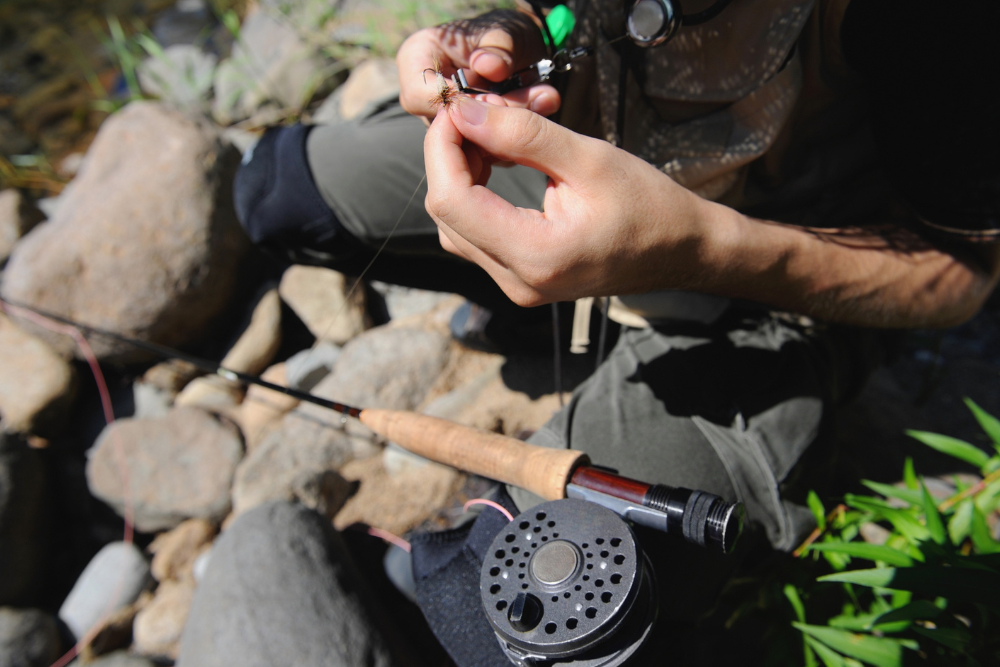
- Flies: The artificial “bugs” made from feathers, fur, thread, and synthetics. Unlike spinning lures, flies are nearly weightless—the line does the work of getting them out there.
These pieces connect through a few simple knots:
- Arbor knot: Attaches backing to the reel
- Loop-to-loop connection: Links leader to fly line (most modern setups use welded loops)
- Improved clinch knot: Ties the fly to your tippet
You don’t need to master complicated knot systems before your first trip. These three basics will get you fishing.

The Fly Rod: Length, Weight, and Action for Beginners
The fly rod is your primary casting tool, and getting the right length and weight up front saves money and frustration down the road. This is not the place to experiment with unusual choices.
For most beginners fishing freshwater trout, panfish, and light bass, the most versatile choice is a 9 ft, 5-weight, medium-fast action rod. This combination handles the widest range of water types and fish species you’ll encounter while learning.
Rod Length
| Length | Best For | Trade-offs |
|---|---|---|
| 7-8 ft | Tight, brushy creeks | Less reach for mending line |
| 9 ft | Standard rivers and lakes | Versatile, good line control |
| 10-11 ft | Specialized nymphing, big rivers | Not necessary for beginners |
A 9 ft rod gives you enough power for longer casts when you need them, plus the line control for accurate presentations. Start here unless you know you’ll only fish tiny, overgrown streams.
Rod Weight Ratings
Rod weight (3 wt, 5 wt, 8 wt, etc.) describes how much fly line mass the rod is designed to cast. Match your rod weight to your typical target species:
- 2-3 wt: Tiny creeks, small trout, and panfish
- 4-5 wt: All-around freshwater—trout, panfish, moderate bass
- 6-7 wt: Larger rivers, big bass, light steelhead
- 8 wt and up: Heavy species (steelhead, salmon, pike, inshore saltwater)
A 5-weight sits right in the middle. It has enough power for moderate wind and larger flies, but still feels responsive with small trout and panfish. This is why nearly every expert recommends it as the first rod.
Rod Action
- Medium-fast: Best for beginners. Forgiving on timing mistakes but still punches into wind when needed.
- Fast: Stiffer, more powerful. Better for experienced casters or throwing big flies in wind.
- Slow: Very flexible, fun for small creeks, but harder to learn proper casting mechanics.
For a look at how different rod actions perform on a real-world steelhead adventure, check out this Steelhead Fishing Trip Report from British Columbia.
The bottom line: a 9’ 5 wt medium fast action rod will handle roughly 70-90% of typical beginner freshwater situations. It’s the solid choice that won’t limit you as your skills develop.
The Fly Reel: What Matters (And When It Doesn’t)
Here’s a truth that surprises many new anglers: for trout and panfish, the fly reel is mostly a line storage device. Unlike spinning reels that actively retrieve lures, a fly reel primarily holds your backing and fly line while you strip line in by hand.
That said, certain features make life easier:
Key Beginner-Friendly Reel Features
- Sized to match your rod: A “4/5” or “5/6” reel pairs with a 5 wt rod
- Reliable, adjustable drag: Disc drag systems are smoother and easier to adjust than click-pawl reels
- Corrosion-resistant materials: Important if you might fish salt water eventually
- Large arbor design: Faster line retrieval and reduces line memory (those annoying coils)
When Reel Quality Matters More
- Fishing larger, powerful fish that run hard (steelhead, salmon, saltwater species)
- Situations where fish routinely take you into your backing
- Harsh environments like saltwater, where corrosion destroys cheap metal reel components
For a starter kit aimed at trout and panfish, prioritize spending on good fly line and a quality rod before paying extra for a high-end reel. Many decent starter reels are cast aluminum or composite; machined aluminum is an upgrade that can wait until you’re chasing bigger fish.
Most fly fishing combo packages include a reel that’s perfectly adequate for learning. The reel seat on a quality rod will hold even basic reels securely.
Fly Line, Leader, and Tippet Basics
This is where many budget fly fishing kits cut corners, and it’s often the most important part of your setup to get right. Line and leader quality affect your casting and presentation more than most beginners realize.
Fly Line Types
| Type | Characteristics | Best For |
|---|---|---|
| Floating (F) | Stays on surface | Default for beginners, dry flies, nymphing |
| Sinking (S) | Sinks uniformly | Deep lakes, certain streamer techniques |
| Sink-tip | Front sinks, back floats | Rivers, streamer fishing |
For your first fly fishing starter kit, a weight-forward (WF) floating line matched to your rod weight is the standard recommendation. If you have a 5 wt rod, you want a WF5F line. This floating line works with dry flies, nymphs under an indicator, and even small streamers. You can fish 90% of freshwater situations with it.
Sinking or sink-tip lines are specialized. They make sense later when you’re targeting deep water or committed to streamer fishing, but they’re harder to learn with.
Leader Guidance
- Standard trout leader: 9 ft, 4X or 5X tapered
- Shorter leaders (7.5 ft): Better in wind or with heavy flies
- Longer leaders (10-12 ft): For spooky fish in crystal-clear water
Understanding Tippet
The X-system measures tippet diameter—higher X numbers mean thinner line. Here’s a basic matching guide:
- 3X: Larger streamers and heavy nymphs
- 4X: Size 10-14 flies, general use
- 5X: Size 14-18 flies, standard trout tippet
- 6X: Size 18-22 flies, picky fish
Don’t obsess over exact tippet formulas at first. Stay within a reasonable size range for your flies and local fish, and you’ll be fine. You’ll develop preferences with experience.
Core Pieces of a Good Beginner Fly Fishing Starter Kit
Not all fly fishing combo packages are created equal. Some kits include everything you need; others leave out critical items. Here’s what an ideal freshwater beginner kit should contain:
Fly fishing tools such as nippers and forceps are handy and essential for trimming line and handling fish safely.
Complete Kit Checklist
| Component | What to Look For |
|---|---|
| Fly rod | 4-piece, 9 ft, 5 wt; graphite/carbon construction; comfortable cork handle |
| Fly reel | 4/5 or 5/6 size; adjustable disc drag; matched to rod weight |
| Backing | 75-100 yards Dacron, pre-spooled |
| Fly line | Weight-forward floating, matched to rod weight |
| Leader | At least one 9 ft tapered leader (4X or 5X) |
| Tippet | Small spool (4X-5X) |
| Flies | Basic set of 12+ patterns in a simple fly box |
| Tools | Nippers and hemostats minimum |
Prioritization tips:
- Rod: Focus on length/weight match and a comfortable grip. Carbon/graphite is standard and durable.
- Line: Kits that include a recognizable, high-quality fly line brand (like Scientific Anglers or similar) are often a better value than kits that tout lots of cheap extras.
- Four-piece rods: Choose these over 2-piece designs. They’re easier to transport, fit in a rod tube for travel, and sacrifice nothing in performance with modern engineering.
A great combo is one where the rod and reel match, the line is high-quality, and the basics are covered. Everything else is upgradable later.
Choosing Kit Specs by Water Type and Target Species
Where you plan to fish and what you want to catch should drive your kit choice more than brand name alone. Here’s how to match your fly fishing gear to your local water.
By Water Type
Small Creeks (tight cover, small trout/panfish)
- Rod: 7’6”-8’6”, 3-4 wt
- Line: WF floating
- Leaders: Shorter (7.5 ft)
- Flies: Small dry flies and nymphs (sizes 14-20)
Medium Rivers (classic trout water)
- Rod: 9’, 4-5 wt
- Line: WF floating
- Leaders: 9 ft, 4X-5X
- Flies: Mixed dry/nymph/streamer selection
Stillwater Lakes and Ponds
- Rod: 9’, 5-6 wt
- Line: WF floating (add sink-tip later if desired)
- Flies: Larger nymphs and streamers work well
Beginner-Friendly Saltwater (schoolie stripers, redfish)
- Rod: 9’, 8 wt
- Reel: Saltwater-safe with strong drag
- Line: WF floating or intermediate
By Target Species
| Species | Rod | Line | Leader | Key Flies |
|---|---|---|---|---|
| Trout | 9’ 5 wt | WF floating | 4X-5X, 9 ft | Dry flies, nymphs, small streamers |
| Panfish/Bluegill | 3-5 wt | WF floating | 5X-6X | Foam dries, small nymphs |
| Largemouth/Smallmouth Bass | 6-7 wt | WF floating | 0X-2X, short | Poppers, streamers |
| Steelhead | 7-8 wt | WF floating or specialized | Heavier tippet | Egg patterns, streamers |
Local conditions like wind, river size, and fishing pressure may nudge you up or down one rod weight. This is where a local fly shop becomes invaluable—they know what actually works on nearby waters.
Best Fly Fishing Combos for Beginners
Choosing the right fly fishing combo is one of the smartest moves a beginner can make. The best fly fishing combos take the guesswork out of matching rod, reel, and line, so you can focus on learning the basics and catching fish—not worrying about compatibility. As you assemble your gear, choosing the right fly fishing boots is also crucial for comfort and safety on the water. With so many options on the market, it’s important to pick a combo that balances quality, value, and ease of use.
Here are some of the best fly fishing combos for beginners, each offering a great starting point for your fly fishing journey:
Starter Kit vs Buying Gear Separately
Buying a pre-matched rod reel combo saves time and guesswork. Building your own setup offers more control but requires research. Here’s how to think through the decision.
Realistic 2026 Price Ranges
- Entry-level full kit (rod, reel, line, leader, some extras): roughly $100-$250
- Piecing together separate components: roughly $250-$450 for quality rod, reel, line, backing, leaders, and basic flies
Complete Kit Advantages
- Pre-matched rod, reel, and line weights—no compatibility headaches
- Often pre-spooled with backing and line, ready to fish
- Fastest path from box to the water for beginners
- Kits like the Orvis Encounter or Redington Crosswater offer solid entry-level quality
Buying Separately Advantages
- Choose a higher-quality line and rod from the start
- Tailor rod weight precisely to your specific fishery
- Mix new and used pieces to stretch your money
- Better for anglers who already know they want a dedicated bass or saltwater setup
Be aware that some “kits” are really partial bundles—just rod and reel, or rod/reel/line without flies or fishing tools. Always read what’s actually included before comparing prices.
For a first-time freshwater trout angler, a well-reviewed beginner combo with a known-brand line is usually the easiest and most cost-effective entry point. You can always upgrade individual pieces later.
What’s Usually Missing from Fly Fishing Starter Kits
Many starter kits leave out small but important items, so budget a bit beyond the kit price. Here’s what to watch for:
Commonly Missing or Weak Components
- Quality fly line: Some kits include generic, low-performance lines that make casting harder
- Extra leaders and tippet spools: You’ll go through these
- Nippers, hemostats, and a proper fly box: Often skipped or cheap versions included
- Polarized sunglasses: Never included, always essential
- Landing net: Rarely included but critical for landing and releasing fish safely
- Floatant for dry flies, strike indicators, split shot: The little things that make techniques work
Critical vs. Upgradable Later
| Critical to Get Right | Can Upgrade Later |
|---|---|
| Fly line quality | Vest or pack |
| Rod fit (length/weight) | Net quality |
| Leaders matched to target fish | Premium tools |
| Basic functional flies | High-end waders |
Treat the very cheap flies, lines, and leaders included in ultra-budget kits as temporary learning tools. They’ll work for practice and your first few trips, but expect to replace them as you develop preferences.
The good news: you don’t need a massive fly selection or premium components to catch fish on your first outings. A focused kit with quality where it counts beats an overloaded kit with mediocre everything.
Essential Accessories Beginners Overlook
The right accessories make learning easier, safer, and more enjoyable—especially when you’re wading rivers and handling fish. Don’t skip these.
Key Accessories
- Polarized sunglasses: Cut glare so you can see into the water; protect your eyes from errant hooks
- Landing net (rubber or rubberized mesh): Safer for fish, easier landings from shore or while wading
- Nippers: For cutting line cleanly
- Hemostats/forceps: For removing hooks safely without damaging fish or fingers
- Floatant: Keeps dry flies riding high on the surface
- Strike indicators: Visual bite detectors for nymph fishing
- Split shot: Small weights to get nymphs down in faster or deeper water
- Simple pack, sling, or vest: Keeps leaders, tippet, flies, and tools organized and accessible

Waders and Boots
- Stockingfoot waders + separate boots: Best for versatility and comfort; essential in water colder than 60°F or for long sessions
- Wading boots with good traction: Felt or rubber with studs (where legal) prevent slips on slick rocks
- Wet wading: In warm water and hot weather, quick-dry pants and wading shoes work fine—no waders needed
Safety Considerations
- Consider a wading staff on deep or fast-moving rivers
- Avoid wading deep in cold water without proper insulation
- Move slowly, shuffle your feet, and never wade where you’re unsure you can safely stand
- Wild water demands respect—know your limits
Beginner Fly Selection Guide
You do not need hundreds of patterns. A small, well-chosen fly box can cover most situations while you’re learning. For example, the hare’s ear is especially effective at imitating larvae, making it a staple in beginner fly boxes. Presentation matters more than having the perfect pattern.
Fly Categories
- Dry flies: Float on the surface, imitating adult insects (Elk Hair Caddis, Adams, Stimulator). The choice of fly fishing leader plays a key role in presenting these flies effectively.
- Nymphs: Sink and imitate immature aquatic insects (Pheasant Tail, Hare’s Ear)
- Streamers: Larger flies imitating baitfish or leeches (Wooly Bugger)
- Terrestrials: Land-based bugs that fall in (foam hoppers, beetles, ants)
A Compact Starter Trout Selection
Aim for 12-24 flies focusing on proven patterns across a small size range:
| Category | Patterns | Sizes |
|---|---|---|
| Dry flies | Parachute Adams, Elk Hair Caddis, Stimulator | 12-16 |
| Nymphs | Pheasant Tail, Hare’s Ear | 14-18 |
| Streamers | Wooly Bugger (black, olive) | 8-12 |
Buy patterns in multiple sizes (12, 14, 16) rather than dozens of different patterns in one size. Size and silhouette matching usually matter more than having the exact fly name a fish supposedly wants.

Casting and Setup Basics for Your First Day
Here’s reassuring news: you don’t need to cast 80 feet. Most trout are caught within 30-50 feet, and many within 15-30 feet. Accurate short casts catch more fish than sloppy long ones.
Assembling Your Outfit
- Connect rod sections (align dots or guides if marked)
- Seat the reel into the reel seat and tighten
- Thread line through all guides starting from the bottom
- Attach leader to fly line (loop-to-loop connection)
- Add tippet to leader if needed (clinch knot)
- Tie on your fly (improved clinch knot)
Check that line pulls off the reel in the direction that matches your casting hand without wrapping around the rod.
What a Basic Cast Accomplishes
You’re smoothly accelerating the line back and forth in the air, then laying it out gently on the water. The goal is a straight line and a natural fly landing—not a cracking bullwhip.
Beginner Casting Tips
- Start with a short line (just a rod length beyond the tip)
- Pause briefly on the back cast to let the line straighten behind you
- Keep your casting hand moving in a straight path, not a big circle
- Practice on grass or an open lawn before fishing
Common Mistakes and Fixes
| Mistake | Cause | Fix |
|---|---|---|
| Tailing loops/tangles | Abrupt power or too-short pause | Slow down, longer pause on back cast |
| Slapping the water | Rod tip traveling in an arc | Straighter casting path |
| Line piling up | Too much line out too soon | Start short, gradually lengthen |
Position yourself slightly downstream and across from likely fish-holding spots. Make sure you have room behind you for the back cast—trees are unforgiving teachers.
Simple Beginner Techniques That Work on Day One
Focus on 2-3 straightforward methods that catch fish consistently. Save the complex techniques for later.
Three Reliable Setups
Dry Fly Only
- Easiest to see—watch for fish rising to the surface
- Cast upstream, let the fly drift naturally (drag-free) toward you
- Set the hook with a quick wrist lift when you see a take
Dry-Dropper
- Buoyant dry fly on top with a small nymph tied below on 12-18” of tippet
- Fish two depths at once—surface and subsurface
- Strike when either the dry fly disappears or you see the line twitch
Indicator Nymphing
- Nymph(s) suspended under a strike indicator with weight as needed
- Ideal for learning subsurface fishing where most trout feed
- Watch for the indicator to pause, dip, or move sideways—any hesitation could be a fish
Basic Streamer Fishing
- Cast across or slightly downstream
- Let the fly swing in the current, then retrieve with short strips
- Imitates a fleeing baitfish and triggers aggressive strikes
- Expect sudden tension or a sharp tug
Recognizing Strikes
- Dry flies: Splash, swirl, or the fly disappears
- Nymphs/indicators: Indicator pauses, dips, or slides sideways
- Streamers: Feel sudden tension or a sharp tug
Set the hook with a gentle wrist lift, not a massive swing. Missing fish is part of learning—you’ll dial it in with personal experience.
Pricing, Budget, and Where to Spend (or Save)
Realistic expectations: a functional beginner fly fishing setup can be assembled in the $150-$400 range, depending on completeness and durability.
Budget Tiers
| Price Range | What You Get |
|---|---|
| Under $150 | Very basic kits; weaker lines and extras; good for curiosity but expect upgrades |
| $150-$300 | Solid entry-level combos from reputable brands; decent warranties; best budget fly fishing kits live here |
| $300-$400+ | Higher quality rods/reels and better lines; “upgrade resistant” for longer |
Where Quality Matters Most
- Rod: Must fit your fishing (length/weight) and feel comfortable
- Fly line: Weight-forward floating line matched to rod weight—don’t cheap out here
- Leaders and tippet: Quality materials that don’t constantly twist or break
Where You Can Save
- Starter reels: Simple but reliable is fine for trout
- Basic tools: Functional nippers and hemostats over premium brands
- Packs and vests: A $30 sling works as well as a $150 one for learning
- Used waders/boots: Safe and in good condition, these can stretch your money
Used Gear Considerations
Buying a used quality rod and reel can be smart—graphite rods last for decades if not cracked. However, lines, leaders, and waders wear out and are usually better bought new. A fly shop can inspect used gear before you buy.
The Local Fly Shop Advantage
Shopping at a local fly shop offers:
- Help matching kit choice to specific local waters
- Quick casting lessons and setup assistance
- Honest answers about what actually works nearby
- The chance to feel rods before buying
Before making a purchase, head into a fly shop for personalized advice and to try out gear. The same price at a fly shop often delivers more value than anonymous online purchases because of this personalized guidance.
Common Beginner Mistakes to Avoid
Learn from others’ expensive lessons. Here’s a quick checklist of pitfalls that cost beginners time and money.
One common mistake is not testing your fly fishing starter kit and reels in different water situations. Make sure to test your gear to assess its durability and performance before heading out for a full day on the water.
Gear Mistakes
- Wrong rod weight: An 8 wt for 8” trout in tiny streams is overkill; a 3 wt for bass is underpowered
- Choosing sinking line first: 90% of early fishing is best done with floating line
- Ignoring leader and tippet quality: Poor materials cause bad turnover, tangles, and lost fish
- Buying huge fly assortments: A focused starter pack beats dozens of random patterns
- Overspending on reels, skimping on line: For trout, the line matters more than the reel
Behavioral Mistakes
- Trying to cast too far instead of learning accurate 25-foot casts
- Wading too deep or fast before learning to read water and current
- Fishing without polarized glasses—you’re blind to what’s happening
- Overthinking fly selection instead of working on presentation
Progress comes from time on the water, not from endlessly upgrading gear before you fish. Get out there.
Recommended Simple Starting Setup (Putting It All Together)
If you’re overwhelmed, start with this. For the typical freshwater trout/panfish angler in North America or Europe, here’s your specific all-around fly fishing starter:
The Confidence-Building Setup
| Component | Specification |
|---|---|
| Rod | 9 ft, 5 wt, 4-piece, medium fast action |
| Reel | Matching 4/5 or 5/6 size with disc drag |
| Line | WF5F (weight-forward 5-weight floating), pre-spooled with backing |
| Leaders | Two or three 9 ft tapered (4X-5X) |
| Tippet | Spools in 4X and 5X |
| Flies | 12-24 patterns: dries, nymphs, and a couple of streamers |
| Tools | Nippers, hemostats, small fly box, strike indicators, split shot |
This setup lets you fish small to medium rivers and ponds for trout, panfish, and modest bass without specialized gear. It’s the same combo most experienced anglers would recommend to their own friends and family just getting started.
Your next step: choose a starter kit that matches this profile (the Orvis Encounter, Redington Crosswater, and similar combos are worth considering), ask questions at a fly shop if you can, and schedule your first practice session on grass, followed by a short local outing. The fish are waiting.
Conclusion and Next Steps
A good fly fishing starter kit comes down to smart, simple choices: a versatile rod and reel combo, matching line, a handful of proven flies, and a few key accessories. You don’t need to spend a fortune or master every technique before your first trip.
Mistakes and tangles are completely normal—every experienced angler has been there. Skills improve faster through actual fishing than by endlessly reading specs or watching videos. The best gear is the gear you take to the water.
Here’s your action plan:
- Decide where you’ll fish first (local creek, nearby river, a pond you can access)
- Pick or assemble a starter kit tailored to that water using this guide
- Practice basic casting and knots on grass before or during your first trip
Take the next step: identify your local fishery, choose an appropriate kit at the same price point that fits your budget, and either visit a fly shop or find a trusted online retailer to get your first setup ready for the season. The world of fly fishing is waiting for you.

FAQ
Do I really need waders for my first season of fly fishing?
Waders are helpful but not mandatory for getting started. In warm summer conditions on small rivers and ponds, many beginners can successfully wet-wade in quick-dry clothing and wading shoes. This is comfortable, simple, and costs less upfront. Add breathable chest waders later when you want to fish in colder water, extend your season into spring and fall, or access deeper rivers where staying dry matters for comfort and safety.
How many flies do I actually need to start?
A focused selection of roughly 12-24 flies is plenty for your first season. Include a few general dry flies (Adams, Elk Hair Caddis), a few nymphs (Pheasant Tail, Hare’s Ear), and a couple of small streamers (Wooly Bugger) in 2-3 sizes each. Learning to present those patterns well is far more important than owning dozens of rarely-used specialty flies. You can expand your collection based on what works in your local waters.
Is a fly fishing starter kit worth it, or should I build my own setup?
For most first-timers, a well-reviewed starter kit is worth it because it saves time and ensures the rod, reel, and line are correctly matched. You avoid compatibility mistakes and get fishing faster. Building a custom setup makes more sense once you’ve fished a season or two and know your preferred fisheries and techniques. At that point, you can make informed decisions about specific rod weights, line types, and premium components that suit your style.
Can I use my starter trout kit for light saltwater fishing?
A 9’ 5 wt trout kit can technically handle very small inshore species in calm conditions, but saltwater generally calls for an 8 wt rod, a corrosion-resistant reel with enough power for larger fish, and appropriate lines designed for the marine environment. If saltwater fly fishing will be a major focus for you, choose a more robust, salt-capable starter outfit from the beginning rather than trying to stretch freshwater gear into service.
What should I buy first if I’m building a kit piece by piece?
The priority order should be: (1) a versatile rod matched to local fish—often a 9’ 5 wt, (2) a matching reel and quality WF floating line, (3) leaders and tippet in appropriate sizes, (4) a small selection of flies and a basic fly box, and then (5) tools and accessories like nippers, hemostats, and polarized sunglasses. This approach ensures you have the core casting and fishing system in place before adding convenience items.